Grand Piano Across Three Provinces, Zero Claims
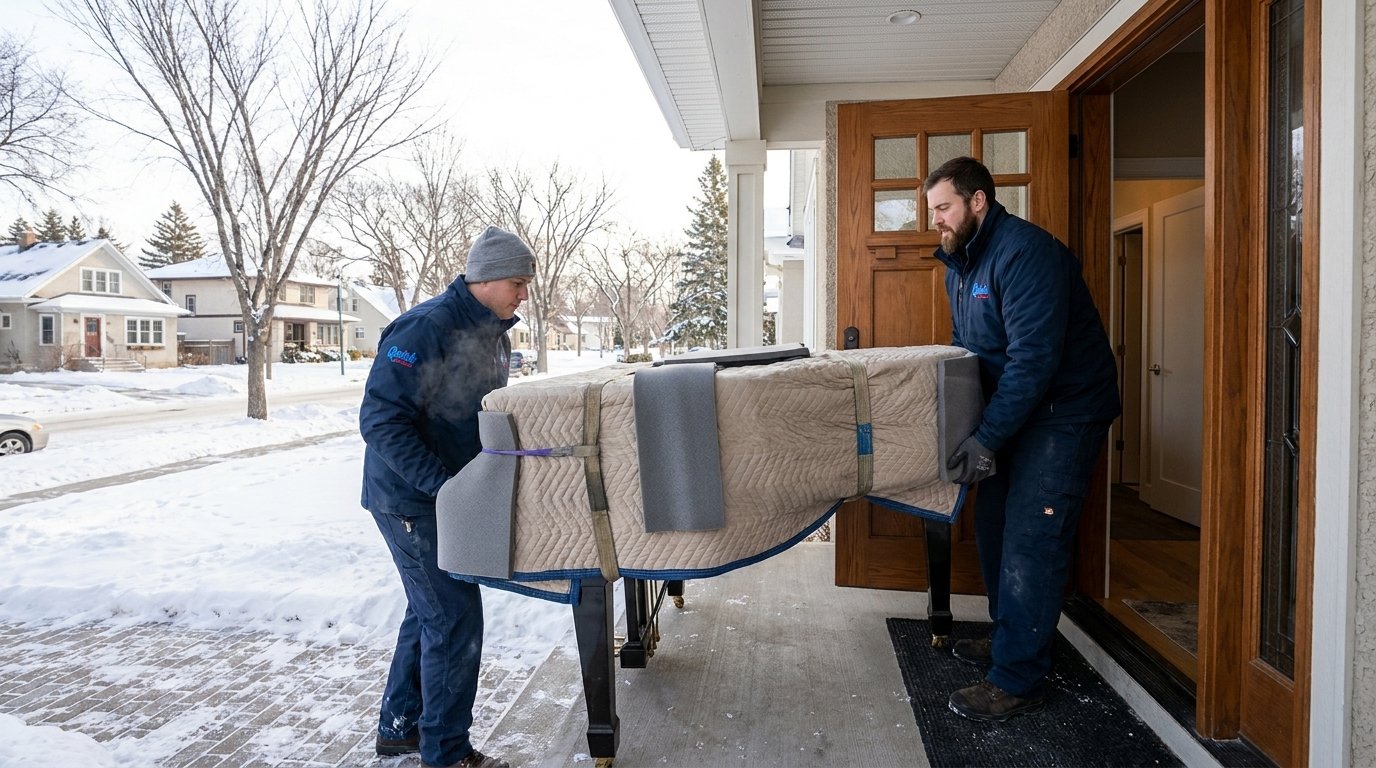
Three provinces. A baby grand piano, two irreplaceable antiques, and a full household worth of belongings. Most people would call that a logistical nightmare. One Winnipeg family called it moving day. And arrived on the other end without a single damage claim.
This is the story of how that happened, and what every homeowner planning a complex move needs to understand before they book anyone.
Why High-Value Moves Require a Different Conversation
Most moving quotes start the same way: how many rooms, what floor, what date. That framework works fine for a standard household move. It breaks down completely the moment a baby grand piano, fine art, or a pair of antiques that belonged to a grandparent enter the picture.
The Winnipeg family at the center of this story had exactly that situation. They were relocating from Manitoba to British Columbia, with a stop in Alberta, and their home included a baby grand piano that had been in the family for over two decades, a mid-century sideboard with irreplaceable provenance, and a hand-carved armoire that had crossed an ocean once already. These were not items that could be inventoried alongside boxes of books and kitchen supplies.
The moment a piano or an antique enters the equation, the move is no longer a logistics problem. It is a stewardship problem.
The first call they made was to Quick Transfer Moving and Storage, a licensed United Van Lines agent operating out of Pandora Avenue East in Winnipeg with 67 years of family-owned experience behind them. The conversation that followed was not about cubic footage. It was about the specific handling requirements of each high-value item, the route, the climate conditions between provinces, and the building access rules at both the origin and destination.
That distinction matters. A moving coordinator who asks the right questions at the outset is doing something most movers skip entirely.
The Piano Problem Most Movers Underestimate
Grand piano moving is a specialty service, not a variation on standard furniture moving. A baby grand piano can weigh between 400 and 600 pounds depending on the model. It has a complex internal mechanism that is sensitive to impact, vibration, and humidity change. Its legs detach for transport but must be reattached with precision. Its finish can be damaged by improper padding, direct contact with metal, or exposure to temperature extremes during a cross-country move in winter.
For this family's move, the piano moving logistics began well before the truck arrived. The moving consultation included a visual assessment of the piano, the staircase configuration at the origin address, the elevator specifications at the destination building, and the specific crating and padding requirements for a multi-day long-distance piano moving scenario.
Custom piano wrap and protection was fabricated specifically for this instrument. The baby grand piano moving team used a combination of moving blankets, foam padding, and a fitted board skirt to protect the case during loading and unloading. The legs were removed and wrapped individually. The lid was secured. The instrument was loaded onto the truck using a hydraulic lift gate, positioned away from the walls to prevent vibration transfer, and secured with ratchet straps rated for the weight.
For moves of this complexity, insured piano movers are not optional. The family confirmed piano moving insurance coverage that reflected the actual replacement value of the instrument, not a standard per-pound liability formula that would have left them significantly undercompensated in the event of damage. This is a step that many families skip because they assume their homeowner's policy covers it. It often does not, or covers far less than the instrument is worth.
Antique Moving Is Not the Same as Furniture Moving
The two antiques in this move presented a different set of challenges. Antique moving requires an understanding that old wood behaves differently from modern manufactured furniture. Joints that have been glued and re-glued over decades can fail under stress. Veneer can lift with humidity change. Hardware can scratch surfaces if padding is not fitted precisely.
Art and antique moving at the professional level begins with documentation. Before either piece was touched, the Quick Transfer team photographed each item from multiple angles, noting existing condition, any prior repairs, and the specific vulnerabilities of each piece. This documentation served two purposes: it created a baseline for the insurance record, and it informed the packing approach.
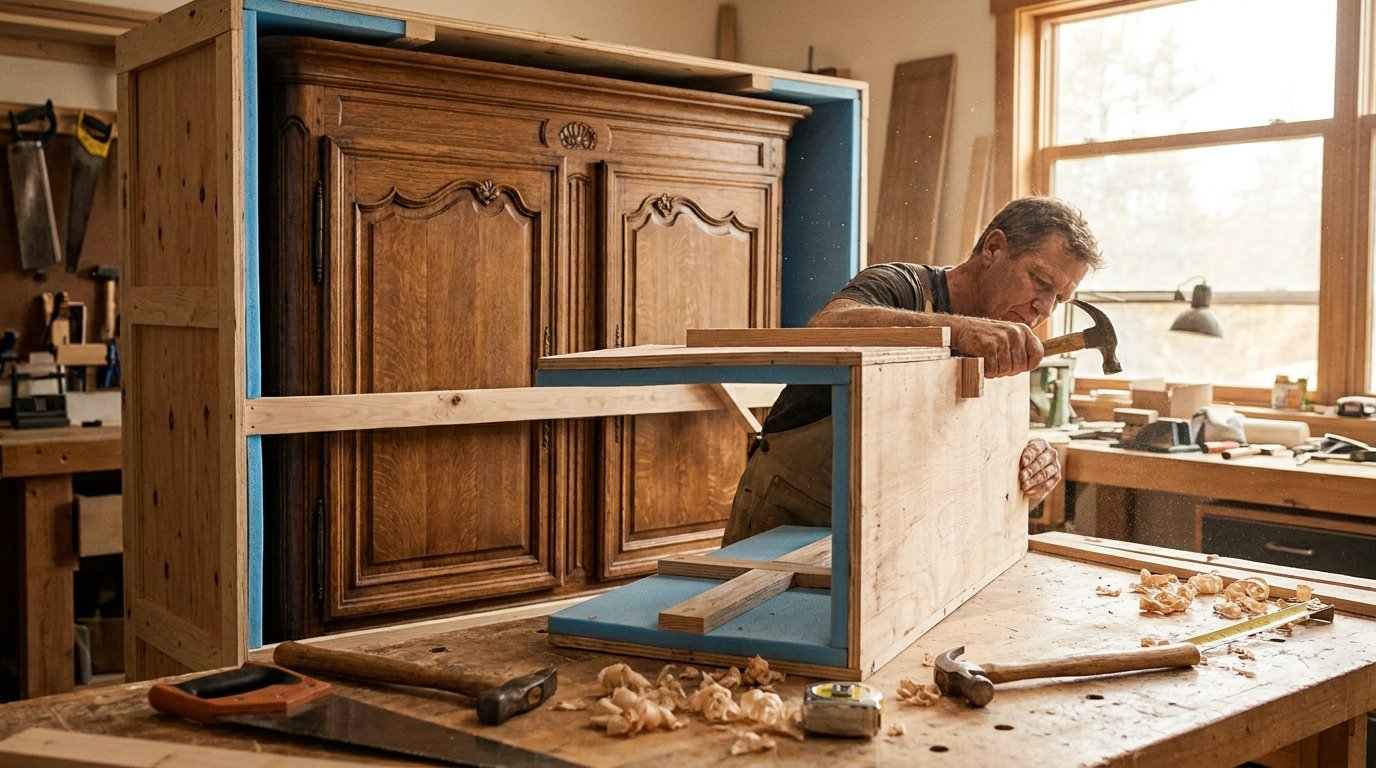
The mid-century sideboard was wrapped in furniture pads and loaded upright, secured against a padded wall section of the truck. The armoire, given its carved exterior, received custom crating services. A wooden crate was built around the piece specifically, with internal bracing that held the armoire suspended away from the crate walls. This is the same approach used for fine art moving and fragile item packing in commercial and museum contexts. It is not standard practice for most residential movers, but it is standard practice when the item cannot be replaced.
Custom crating is not an upsell. It is the difference between arriving with an heirloom and arriving with a claim.
Fragile item moving of this kind requires full service moving capability, not labor-only moving help. The crew managing the antiques were experienced in specialty item moving, not general household goods moving. That experience shows in the handling decisions made on the spot. How a piece is tilted on a staircase, how it is positioned in the truck relative to other items, how it is secured for a multi-day haul through varying road conditions.
Climate, Distance, and the Cross-Country Variable
A cross-country move from Winnipeg to British Columbia in winter introduces variables that a local moving estimate rarely accounts for. Temperature swings between Manitoba and the mountain passes of BC can be dramatic. Wood expands and contracts. Condensation can form on cold surfaces when they enter a warm environment. A piano that has been in a climate-controlled home for twenty years is not automatically ready to survive a January freight haul without preparation.
Piano climate controlled storage played a role in this move even though the family was not using long-term storage. During the transit stop in Alberta, the instruments and antiques were held in a climate-controlled storage facility for two days while the family managed the overlap in their possession dates. This is a common scenario in long-distance moving and one that most families do not anticipate when they book. Having a mover who operates their own storage facility, rather than subcontracting to an unknown third party, meant the chain of custody never broke.
This is one of the structural advantages of working with a direct carrier rather than a moving broker. A broker coordinates your move but does not own the trucks, the warehouse, or the storage facility. When your piano is sitting in storage in transit in Alberta, you want to know who is responsible for it. With a licensed United Van Lines agent operating from their own Pandora Avenue East facility, the answer is clear.
The route was planned to minimize highway sections with the roughest road surface. Loading and unloading times were scheduled to avoid the coldest hours of the day where possible, reducing the risk of condensation when warm items met cold air. These are the kinds of decisions that experienced moving coordinators make without being asked, because they have seen what happens when they are not made.
What the Family Did to Prepare Their End
Professional piano moving and white glove moving for antiques puts most of the responsibility on the mover, but the family had a role in making the move go smoothly.
First, they booked early. Peak season moving in Winnipeg compresses booking windows significantly. Specialty services like grand piano moving, custom crating, and white glove moving have even tighter availability than standard residential moving. The family booked their move twelve weeks in advance, which gave the moving coordinator time to assess the piano, source the crating materials for the armoire, and confirm building access rules at both ends.
Second, they accepted the moving consultation process fully. This meant a video walkthrough of the home, detailed measurements of doorways and staircases, and a clear inventory that distinguished high-value items from standard household goods. The moving estimate was itemized, so the family understood exactly what they were paying for and why.
Third, they confirmed their moving insurance in writing before the truck arrived. Piano moving insurance and coverage for the antiques was documented separately from the standard household goods moving coverage. This is not bureaucratic overcaution. It is the step that determines whether a claim is resolved quickly or becomes a dispute.
The Result and What It Proves
The family arrived in British Columbia with every item intact. The baby grand piano was reassembled by the delivery team and a piano tuning after moving was arranged for the following week, as is standard after any long-distance piano transportation. Both antiques were uncrated and inspected in the presence of the family. The armoire showed no damage. The sideboard arrived in the same condition it left.
Not a single claim was filed.
This outcome was not luck. It was the result of choosing a full service moving company with the specific capabilities the move required: professional piano moving, art and antique moving, custom crating, climate controlled storage in transit, and end-to-end carrier accountability through the United Van Lines network.
If your next move involves a piano, antiques, fine art, or any item where damage is not an acceptable outcome, the question to ask every mover you consider is not what they charge. The question is whether they have done this specific type of move before, whether they carry the right moving insurance, and whether they are a direct carrier or a broker who will hand your belongings to someone you have never spoken to.
Quick Transfer Moving and Storage has been answering those questions in Winnipeg since 1957. They are a third-generation family business, a licensed United Van Lines agent, and a direct carrier with their own warehouse and fleet on Pandora Avenue East.
Get a free moving quote from Winnipeg's United Van Lines agent and find out what a properly planned move looks like from the first call to the final delivery.

Ralph Mueller
President
Ralph Mueller leads Quick Transfer Moving and Storage through its third generation of serving Winnipeg families and businesses. As President, he oversees the company's full-service operations from residential and commercial moves to specialized freight and international logistics—while maintaining the United Van Lines partnership and the physical facility on Pandora Avenue East that anchors the company's local credibility. His perspective reflects a commitment to reliability and professionalism that has built Quick Transfer's reputation over 67 years in the market.
More from Ralph Mueller →