How to Read a Winnipeg Moving Estimate Line by Line

A moving estimate should give you clarity. Too often it gives you a false sense of security and a surprise invoice on moving day. Here is how to read every section of a Winnipeg moving estimate so that hidden fees, deposit traps, and vague coverage clauses never catch you off guard.
Why the Estimate Is the Most Important Document You Will Sign
The moving estimate is not a formality. It is the legal and financial foundation of your entire move. Every conversation you have had with a sales rep, every promise made on the phone, every assurance about careful handling. None of it matters if it is not reflected in writing on that document. Winnipeg consumers have lost thousands of dollars to movers who provided a low verbal quote and then produced a very different bill on moving day. The estimate is your only protection.
CBC Manitoba has reported on Winnipeg residents who paid deposits to movers that never showed up, and on moves where final charges bore almost no resemblance to the original quote. These are not rare edge cases. They are the predictable result of not reading the estimate carefully before signing.
The estimate is not a formality. It is the legal and financial foundation of your entire move.
A legitimate mover. Particularly a licensed carrier like a United Van Lines agent operating from a physical facility. Will produce an estimate that is specific, itemized, and defensible line by line. If the document in front of you is vague, that vagueness is not accidental.
The Binding vs. Non-Binding Distinction: Start Here
The first thing to look for on any moving estimate is whether it is classified as binding or non-binding. This single distinction determines whether the number you are looking at is a ceiling or a suggestion.
A binding estimate means the mover has agreed to complete the job for the quoted price, regardless of how long it takes or how heavy the shipment turns out to be. A non-binding estimate means the final bill can increase based on actual weight, hours worked, or services rendered. Non-binding estimates are not inherently dishonest, but they require you to understand the variables that could push the price up.
In Winnipeg, local residential moving and apartment moving is often quoted on an hourly basis, which is a form of non-binding estimate. Long-distance moving and cross-country moving through networks like United Van Lines is typically quoted on a weight-and-distance basis, which can be binding or non-binding depending on the agreement. Ask directly which type you are looking at before you read another line.
Line-by-Line: What Each Section Actually Means
Once you know whether the estimate is binding or non-binding, move through the document section by section. Here is what to look for.
Base rate or hourly rate. This is the core cost of the move. The crew, the truck, and the time. For local moving and short-distance moving within Winnipeg, this is usually expressed as a crew rate per hour with a minimum number of hours. Confirm whether travel time from the mover's facility to your home and back is included in the billable hours. Some movers charge portal-to-portal; others charge only from the moment they arrive at your door. The difference on a Winnipeg move can be one to two hours of additional billing.
Fuel surcharge. A legitimate line item. What you are checking for is whether it is a fixed amount or a percentage of the total. Percentage-based fuel surcharges compound with every additional service you add. Ask for the calculation method in writing.
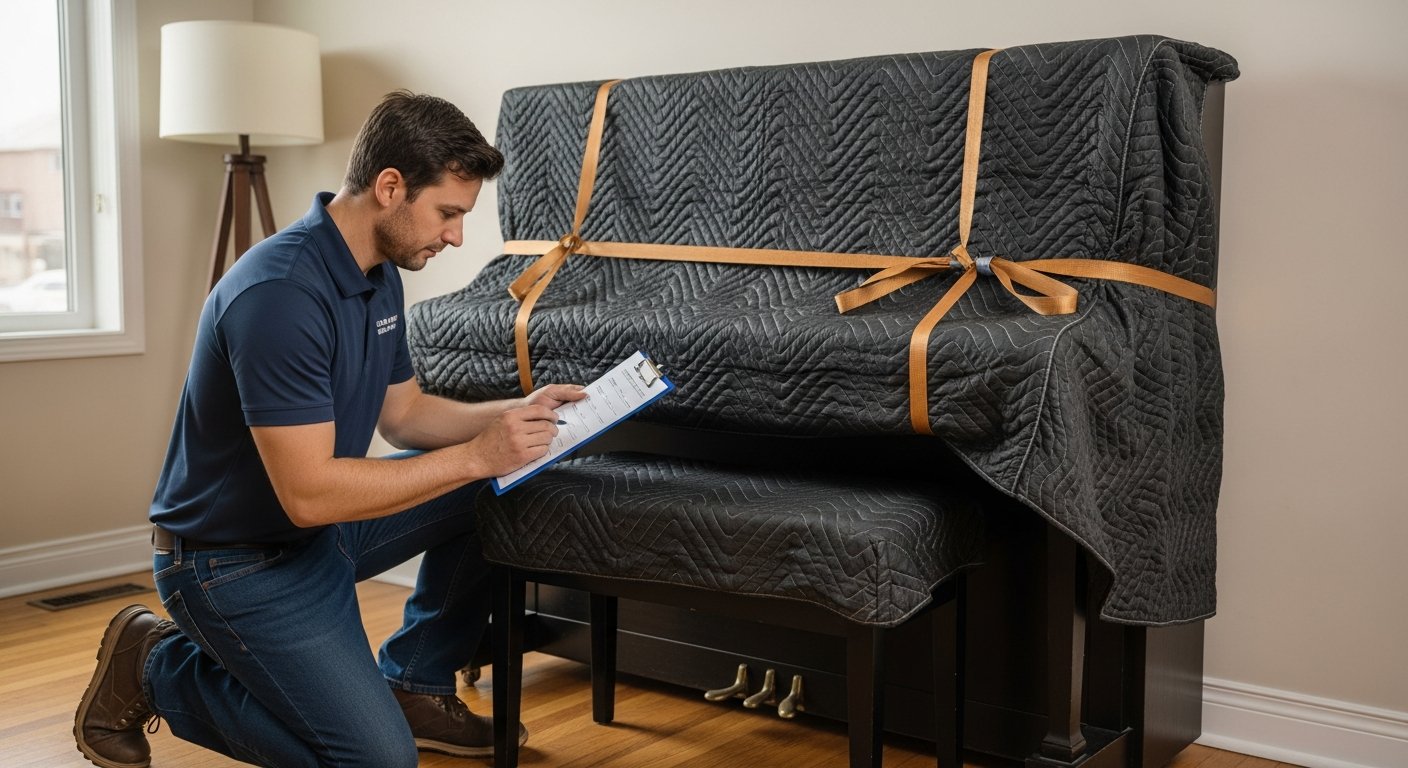
Specialty item handling. This line covers services like piano moving, grand piano moving, baby grand piano moving, safe moving, pool table moving, and heavy item moving. If you have a piano in your home, this line should be present and specific. It should name the item, the floor it is on, and whether piano hoisting, multi-story piano moving, or special equipment is required. A line that says simply "specialty items. Additional charges may apply" is not an estimate. It is a blank check. A professional piano moving service will itemize the piano work separately, including piano wrap and protection, piano crating if required, and any piano climate-controlled storage if the instrument needs to be held before delivery.
Packing and unpacking services. If you have asked for full-service moving that includes packing, fragile item packing, or packing and unpacking, this should be broken out with material costs listed separately from labor. Moving boxes supply, packing material supply, and packing supplies are real costs. A mover who buries them in a single line called "packing" is obscuring what you are actually paying for. Ask for a materials list.
Storage charges. If your move involves storage in transit, short-term storage, or long-term storage at a facility, the estimate must specify the rate per month or per week, the access terms, and whether the storage is climate-controlled. For items like antiques, fine art, art and antique moving loads, or wine storage, climate-controlled storage is not optional. It is a requirement. An estimate that vaguely references "storage if needed" without rates is a liability waiting to happen. Winnipeg winters alone make unheated storage units a genuine risk for temperature-sensitive belongings.
Additional services. This is the line that catches the most people off guard. Additional services can include furniture assembly, furniture disposal, electronics moving, appliance handling, crating services, custom crating, and delivery acceptance. Each of these has a real cost. If this line reads "TBD" or "as required," push back. Ask the mover to walk through your home or conduct a proper moving consultation and quote every service you are likely to need before you sign.
Mileage or distance charges. For long-distance moving or international moving, this section should specify the route, the distance calculation method, and whether the rate changes if the route changes. For cross-country moving and interstate moving, this section should also reference the carrier network. If Quick Transfer is your mover, this is where the United Van Lines agent relationship matters. Your shipment moves within a regulated, accountable national network, not through an unknown subcontractor chain.
The Deposit Clause: Read Every Word
The deposit section of a moving estimate deserves its own careful read. A deposit is normal and reasonable. What you are looking for is the refund policy.
A trustworthy mover will specify the deposit amount, the conditions under which it is refundable, and the deadline for cancellation without penalty. If the deposit is described as non-refundable with no conditions, that is a red flag. If the cancellation window is extremely short. 24 or 48 hours. That is a red flag. If there is no written refund policy at all, do not sign.
A deposit is normal and reasonable. What you are checking is whether you can get it back if something goes wrong.
CBC Manitoba's consumer reporting on Winnipeg moving scams consistently identifies large non-refundable deposits as one of the primary mechanisms used by fraudulent operators. A legitimate mover with a physical facility, a real fleet, and 67 years of Winnipeg reputation does not need to hold your deposit hostage. The deposit protects the mover's scheduling. It should not function as a trap.
Coverage and Liability: What Your Belongings Are Actually Worth Under This Contract
Every moving estimate in Canada includes some form of liability coverage language. Most people skip it. That is a mistake, particularly if your move includes high-value items like pianos, fine art, antiques, or electronics.
The standard industry coverage is called Released Value Protection. It is the minimum coverage required by law and it is, in most cases, nearly worthless for high-value goods. Under Released Value Protection, your mover is liable for a fixed amount per pound of your belongings. Typically 60 cents per pound. A 500-pound baby grand piano worth $25,000 would be covered for $300 under this standard. That number is not a typo.
A legitimate estimate will also offer Full Value Protection, which holds the mover liable for the replacement or repair cost of any item that is lost, damaged, or destroyed. This is what moving insurance should look like. If the estimate in front of you mentions only the standard Released Value coverage and does not offer or explain Full Value Protection, ask directly. For piano moving insurance, insured piano movers, and the movement of any specialty item or fragile item moving load, Full Value Protection is the appropriate coverage.
Also look for exclusions. Many coverage clauses exclude items packed by the owner, items of extraordinary value not declared in advance, and items in certain storage configurations. If you are using containerized storage, portable storage containers, or any form of self-storage as part of your move, confirm that your coverage applies inside those containers.
What a Clean, Trustworthy Estimate Looks Like
A clean moving estimate from a reputable Winnipeg mover will have several characteristics that distinguish it from a problematic one.
It will be specific. Every service is named, not implied. Piano moving is listed with the type of piano and the floor. Storage is listed with a rate and access terms. Packing is listed with materials itemized separately.
It will have a named carrier. You will see the legal name of the company operating the truck, their carrier number, and their insurance information. If you are using a United Van Lines agent, the estimate will reference the United Van Lines network, which provides an additional layer of accountability and reach that most local Winnipeg movers cannot offer.
It will include a written deposit and cancellation policy. The refund terms will be explicit, not implied.
It will offer coverage options. You will be offered at minimum Released Value and Full Value Protection, and the difference will be explained.
It will be the product of a proper moving consultation. The best movers in Winnipeg. Whether you are planning a local move, a commercial relocation, a corporate relocation, or an international move. Will conduct an in-home or video survey before producing an estimate. They will ask about piano moving and storage needs, about art and antique moving requirements, about fragile item packing, about storage in transit. The estimate will reflect those conversations in specific line items.
If the estimate you are looking at was produced in five minutes over the phone with no survey, treat it as a placeholder, not a contract.
How to Compare Estimates Across Multiple Movers
The Canadian Association of Movers and CBC consumer guidance both recommend getting at least three written quotes before booking a Winnipeg mover. That is sound advice. The challenge is that comparing estimates from different movers is only meaningful if you are comparing the same scope of work.
Before you request quotes, write down every service you need. Include the number of crew members you expect, whether you need packing services, whether any items require specialty handling like piano moving or heavy item moving, whether storage is part of the plan, and the exact origin and destination addresses. Give every mover the same brief. Then compare the estimates line by line, not total to total.
A low total from one mover often reflects a narrower scope of services, not a better price for the same work. When you add the missing services back in, the comparison frequently reverses. A mover who produces a thorough, specific estimate. Even if the initial total is higher. Is telling you something important about how they operate.
Conclusion: Your Estimate Is Your Protection. Treat It That Way
Reading a moving estimate line by line is not a complicated skill. It is a discipline. The families and businesses that get burned on moving day are almost never surprised by what happened. They are surprised that something they did not read turned out to matter.
Quick Transfer Moving and Storage has been serving Winnipeg from its own facility on Pandora Avenue East since 1957. As a licensed United Van Lines agent, every estimate produced reflects the standards of a direct carrier. Specific, itemized, and backed by one of North America's most recognized moving networks. Whether you are planning a residential move, a commercial relocation, a corporate relocation, long-distance moving, or a specialized move involving piano moving, fine art, or custom crating, the estimate you receive will tell you exactly what you are getting and what it costs.
If you are planning a move in Winnipeg and want an estimate you can read and trust, get your free moving quote from Quick Transfer. Winnipeg's United Van Lines agent.

Ralph Mueller
President
Ralph Mueller leads Quick Transfer Moving and Storage through its third generation of serving Winnipeg families and businesses. As President, he oversees the company's full-service operations from residential and commercial moves to specialized freight and international logistics—while maintaining the United Van Lines partnership and the physical facility on Pandora Avenue East that anchors the company's local credibility. His perspective reflects a commitment to reliability and professionalism that has built Quick Transfer's reputation over 67 years in the market.
More from Ralph Mueller →