The Cheapest Mover Just Cost You Everything

The call came three days after moving day. The antique dresser. The one that belonged to your grandmother. Arrived in pieces. The company that moved it? A broker who subcontracted the job to a crew you never vetted. Nobody is returning your calls.
This is not a rare story. It is one of the most common ones in the moving industry, and it plays out every summer in Winnipeg and across Canada. The good news is it is entirely preventable. If you know what to look for before you sign anything.
The difference between a licensed carrier and a moving broker is the difference between accountability and a phone that stops ringing after moving day.
What a Moving Broker Actually Does
When you search for movers online, a significant portion of the results you see are not moving companies. They are brokers. A broker collects your deposit, sells your job to a third-party carrier, and steps out of the transaction. The crew that shows up at your door may have no connection to the company you booked, no knowledge of what you were promised, and no obligation to honour the quote you received.
This is not hypothetical. CBC Manitoba has documented the pattern repeatedly, and consumer protection advocates consistently warn Winnipeg residents to verify insurance and bonding, get written quotes, and understand exactly who will be touching their belongings.
The fix is straightforward: book a licensed direct carrier, not a broker. A direct carrier owns the trucks, employs the crew, and is legally accountable for your move from start to finish. Quick Transfer Moving and Storage operates as a licensed United Van Lines agent out of a physical warehouse on Pandora Avenue East in Winnipeg. That means one company, one contract, one point of accountability. No handoffs to unknown subcontractors.
The 7 Things a Cheap Quote Never Includes
Low-ball quotes are engineered to win the booking, not to reflect the actual cost of a professional move. Here is what typically disappears between the quote and the invoice.
1. Stair and elevator fees. Many brokers and discount movers add per-flight or elevator-access charges on moving day. These are not mentioned in the quote.
2. Long-carry fees. If the truck cannot park within a certain distance of your door, you pay extra. The quote assumed ideal conditions.
3. Fuel surcharges. Added at the end, often without clear disclosure upfront.
4. Extra trip charges. An underpowered crew with an undersized truck will sometimes require multiple trips. You pay for each one.
5. Damage liability limits. Discount movers often provide only released-value protection. Approximately 60 cents per pound per item. A 200-pound antique worth $4,000 is covered for $120. Full-value protection is a separate conversation that cheap quotes never start.
6. Packing materials. A quote for labor-only moving assumes you have packed everything yourself, correctly, with the right materials. If you have not, the crew will charge for supplies on the spot.
7. Storage surprises. If your possession date shifts, your belongings may go into storage. Discount movers charge daily rates that were never disclosed. With a direct carrier like Quick Transfer, storage in transit is part of a coordinated plan. Not a penalty.
Why High-Value Items Change Everything
Standard moving practices are designed for standard household goods. When your move includes a grand piano, fine art, antiques, or high-value electronics, the margin for error collapses to zero.
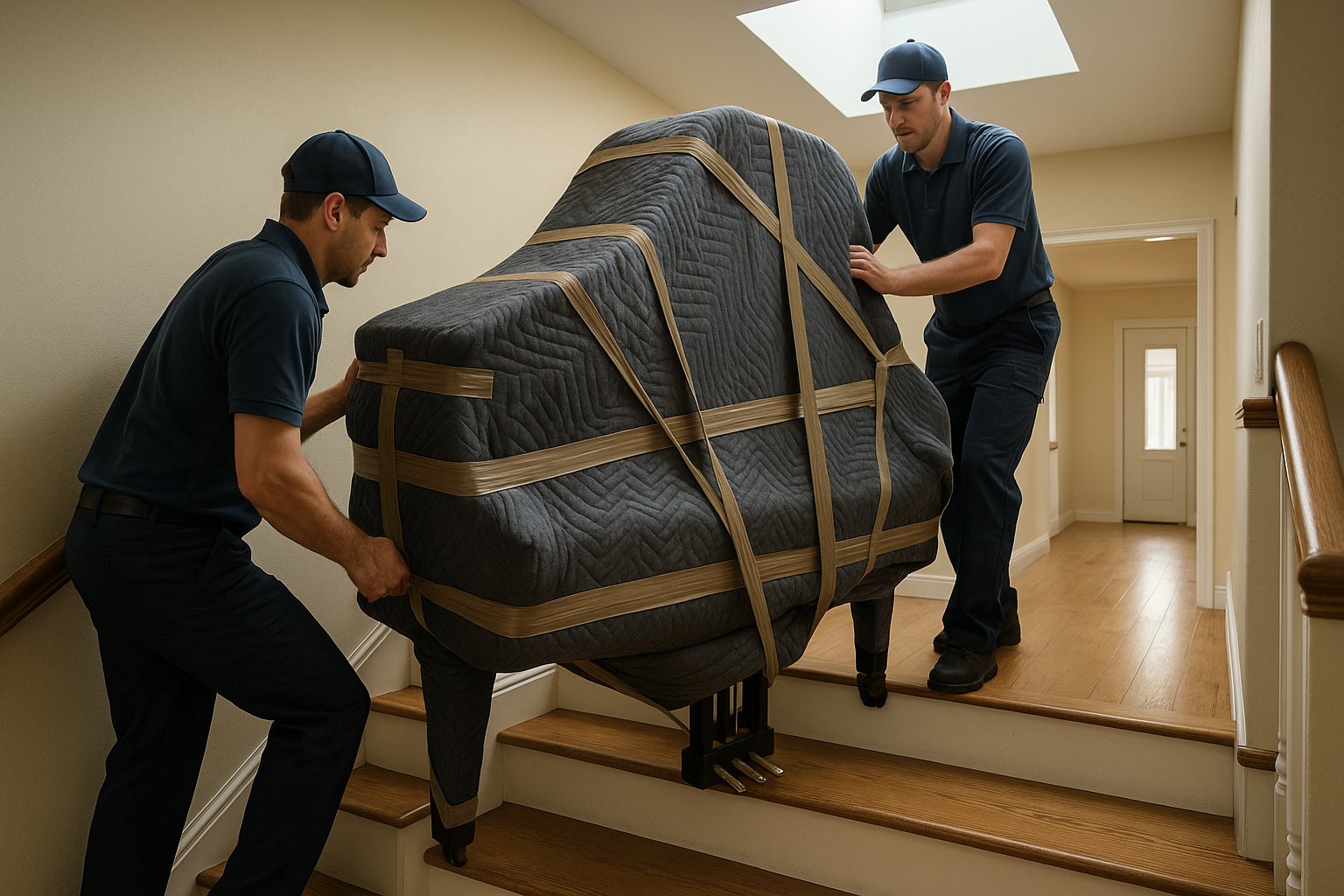
Piano moving is not furniture moving with a heavier object. A baby grand piano or concert piano requires disassembly, custom piano wrap and protection, precise piano lifting technique, and in multi-story homes, specialized piano hoisting equipment. An upright piano moving job that looks simple from the outside can become a structural problem the moment an undertrained crew tries to navigate a staircase. Professional piano moving includes piano crating for long-distance piano transportation, piano climate controlled storage when timing gaps exist, and piano tuning after moving to restore the instrument once it settles.
Art and antique moving demands the same level of care. Fine art moving involves custom crating built specifically for each piece. Not generic boxes from a hardware store. Fragile item packing for antiques requires materials and technique that a discount crew simply does not carry. White glove moving, in its proper definition, means every item is inventoried, wrapped, moved with trained hands, and placed exactly where it belongs in the new space.
Quick Transfer has handled all of it. Grand piano moving, commercial piano moving, school piano moving, antique moving, fine art moving, specialty item moving, and fragile item moving. As part of a full-service moving and storage operation backed by 67 years of Winnipeg experience and the United Van Lines network.
White glove moving is not a marketing phrase. It is a specific set of practices that protect what cannot be replaced.
What Corporate and HR Clients Need to Know
For HR managers and corporate office managers coordinating employee relocations, the stakes are different. But the principle is the same. A failed move reflects on the company. An employee whose household goods arrive damaged, delayed, or held by an unaccountable broker does not forget it.
Corporate relocation and business relocation require a moving coordinator who understands timelines, documentation, and the liability implications of employer-sponsored moves. Commercial moving and commercial relocation involve IT equipment, office furniture, and in some cases, sensitive documents and file storage or document storage that require controlled access and chain-of-custody handling.
Quick Transfer's capacity for cross country moving, long distance moving, and international moving. All coordinated through the United Van Lines network. Means a Winnipeg-based HR team can manage a national or international employee relocation through one trusted partner. The reach is real. The accountability is local.
For office moves specifically, the concern is downtime. Commercial piano moving for performance venues, warehouse moving for industrial clients, trade show moving for marketing teams. Each has a different set of constraints, and each requires a mover who plans around your business timeline, not just a truck availability window.
Storage Is Part of the Move, Not an Afterthought
One of the most common points of failure in a move is the gap between possession dates. You hand over your keys on the 29th. You get access to the new place on the 3rd. What happens to your belongings in between?
If you booked a broker, this is where the hostage-freight scenario begins. Your belongings go into an unknown facility at an undisclosed rate, and you have no leverage.
If you booked a direct carrier with real infrastructure, storage in transit is a planned component of the move. Quick Transfer's physical warehouse on Pandora Avenue East provides secure storage, climate controlled storage for sensitive items, and short term storage or long term storage depending on what your timeline requires. For high-value items, that means piano climate controlled storage, fine art storage, furniture storage, and inventory storage under one roof. Accessible, insured, and managed by the same team handling your move.
For businesses, the storage options extend further: commercial storage units, warehouse storage, pallet storage, document storage, file storage, and business storage solutions for companies in transition. Controlled access storage and security monitoring are standard, not upgrades.
How to Vet a Mover Before You Sign Anything
Here is the practical checklist. Use it for every mover you consider.
Ask if they are a carrier or a broker. If they cannot answer clearly, assume broker. A licensed carrier like Quick Transfer can point you to their carrier number and their United Van Lines agent credentials.
Get a written, itemized quote. Not a range. Not a ballpark. A written document that specifies what is included, what triggers additional charges, and what the valuation coverage options are. MoveAdvisor's 2026 Winnipeg benchmarks put the average local move around $1,067. If a quote is dramatically lower, something is being left out.
Verify insurance and bonding. Ask for documentation. A legitimate mover provides it without hesitation.
Ask about the crew. Are they employees of the company or day-labor subcontractors? This matters for accountability and for the consistency of training.
Confirm storage terms upfront. If there is any chance of a timing gap, get the storage rate in writing before moving day.
Check for a physical address. A mover with a real warehouse. Like Quick Transfer's Pandora Avenue East facility. Is accountable in a way that a virtual office operation is not.
67 Years of Doing This the Right Way
Quick Transfer Moving and Storage was founded in 1957. The third generation of the Mueller family is now stepping forward, carrying a reputation built on relationships, reliability, and the kind of care that only comes from treating every move as if it were your own.
As a licensed United Van Lines agent, Quick Transfer brings the reach of one of North America's most recognized moving networks to every job. Local moving in Winnipeg, apartment moving across the city, long distance moving to any Canadian province, and international moving coordinated through a global network. The infrastructure is real: a physical warehouse, a professional fleet, trained crews, and the operational depth to handle everything from a small move to a full commercial relocation.
The antique dresser that arrived in three pieces did not have to end that way. The right mover, with the right credentials and the right process, makes sure it does not.
Get a free moving quote from Winnipeg's United Van Lines agent. Contact Quick Transfer Moving and Storage today.

Ralph Mueller
President
Ralph Mueller leads Quick Transfer Moving and Storage through its third generation of serving Winnipeg families and businesses. As President, he oversees the company's full-service operations from residential and commercial moves to specialized freight and international logistics—while maintaining the United Van Lines partnership and the physical facility on Pandora Avenue East that anchors the company's local credibility. His perspective reflects a commitment to reliability and professionalism that has built Quick Transfer's reputation over 67 years in the market.
More from Ralph Mueller →